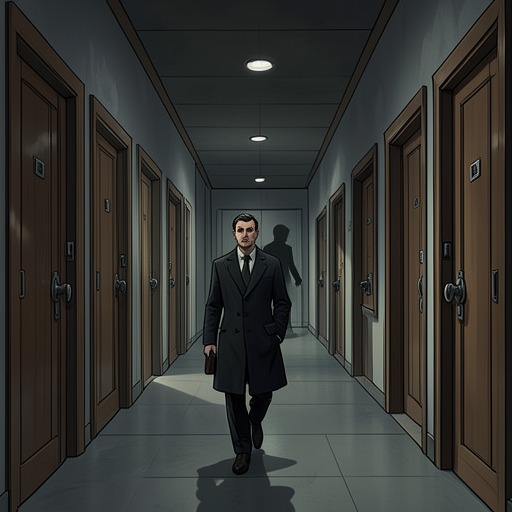
Wadi Sir Detention Facility
Guantanamo DiaryWadi Sir Detention Facility was the Jordanian General Intelligence Department’s headquarters in Amman and, according to Human Rights Watch, served as a proxy jail for the CIA. Its layered arrangement of cells, interrogation rooms, and restricted visiting spaces made location itself part of detention: prisoners could be held apart, kept from one another, and concealed from outside monitors. Mohamedou Ould Slahi’s account of being moved to a cellar to evade International Committee of the Red Cross visits shows how that control operated in practice.
Setting and Structure
Human Rights Watch described the headquarters as a facility covering nearly an acre, with a four-story detention building. Administrative offices and interrogation rooms were on the second floor; visiting rooms were on the ground floor. During the organization’s 2007 inspection, detainees were being held on the second floor, although cells also occupied the ground and third floors and, in smaller numbers, the fourth. The fourth floor included collective cells and a section the facility’s director called the women’s section.
The building also had a basement. Human Rights Watch recorded that many prisoners said they had been taken there for the most violent treatment. Its account distinguishes the facility’s documented layout from prisoners’ reports about how particular spaces were used, a distinction important in describing a site whose operations were not fully visible to outsiders.
Detention and Restricted Access
Human Rights Watch reported that, from 2001 until at least 2004, Jordan’s General Intelligence Department held prisoners whom the CIA apparently wanted kept out of circulation, and later returned some of them to the CIA. Slahi and at least thirteen others were sent to Jordan during this period. The facility’s standard single-person cells and prohibition on communication between detainees reinforced their separation; some prisoners nevertheless managed to communicate through the cells’ rear windows, which faced the central courtyard.
Slahi’s account describes another means of limiting outside access. He found prison rules on a paper left on a door, including a provision that the International Committee of the Red Cross visited every fourteen days and an instruction not to discuss a political case with its representatives. He later understood that, during his eight-month stay in Jordan, guards moved him to the cellar for a couple of days at each visit so that the organization would not find him. The temporary move he had initially taken for a step toward release was, in his account, part of this effort to hide him from monitors.
Slahi’s Place in the Facility’s History
Slahi’s detention in Jordan formed one stage of a concealed international transfer. His family believed for almost a year that he remained in Mauritanian custody, while he had in fact been transferred to Jordan, then to Bagram Air Base in Afghanistan, and later to Guantánamo. His brother continued delivering money and clean clothes to the Mauritanian prison, unaware that Slahi was elsewhere. The false appearance of continued custody at home demonstrates how concealment extended beyond the walls of Wadi Sir to the information available to a detainee’s family.
The manuscript also situates Slahi’s account within a wider record. Human Rights Watch researchers inspected the facility in 2007 and published descriptions of its layout and detention practices; public investigations and records about Slahi’s ordeal provide further context. The editor’s notes explain that they draw on public sources and close reading, but do not attempt to reconstruct redacted text or disclose classified material. Accordingly, the account can connect Slahi’s reported experience to the known structure and role of Wadi Sir while preserving the limits of what can be established about concealed operations.
Significance
Wadi Sir was more than a setting on Slahi’s route through detention. Its floors and rooms organized who could meet, who could observe, and who could disappear from view. The contrast between the scheduled Red Cross visits and the recurring move to the cellar makes the facility’s geography inseparable from its information controls: access existed on paper, while the movement of a prisoner could frustrate it in practice. The surviving descriptions therefore illuminate both the physical institution and the wider system of secret detention in which it operated.